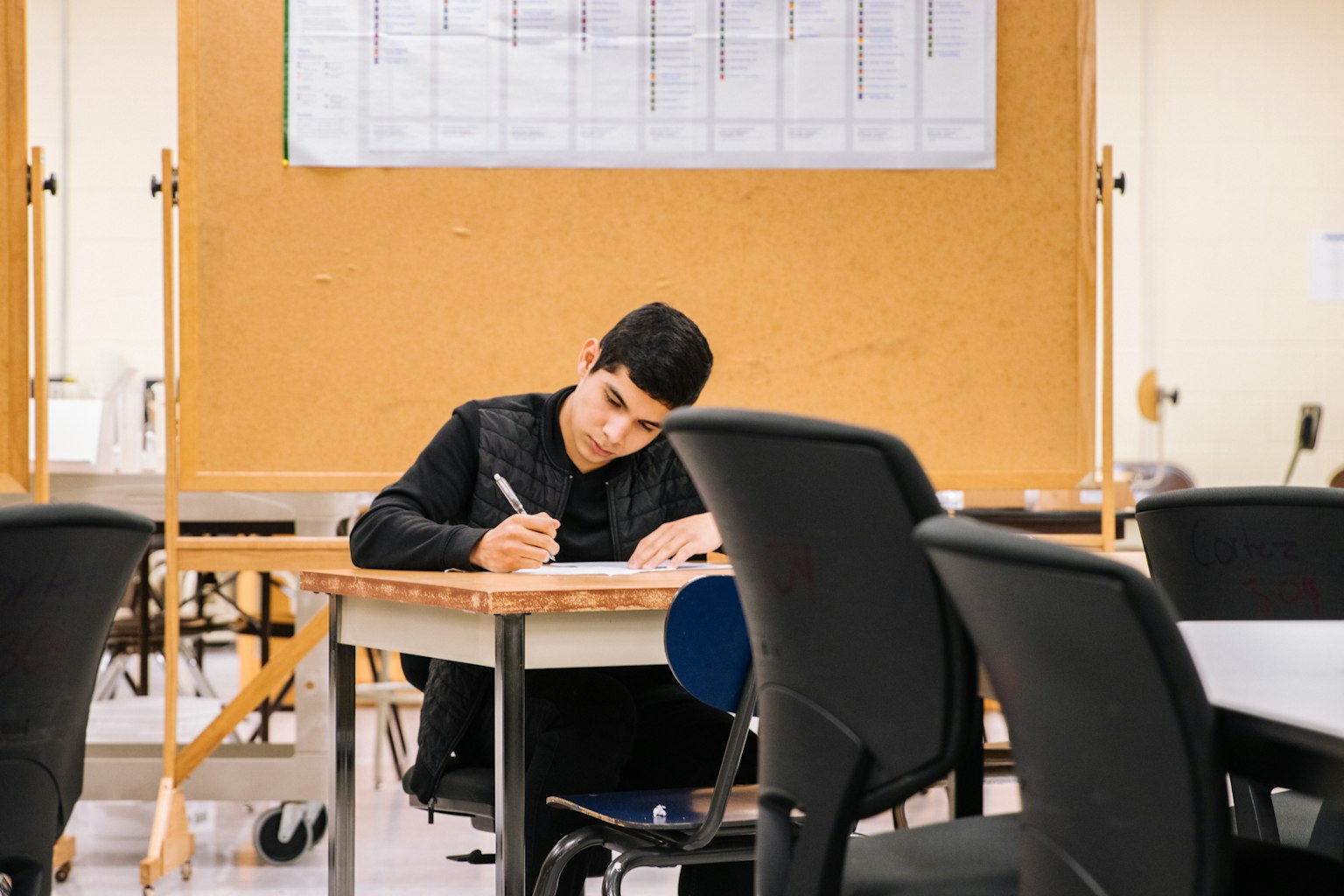

Your child rereads the chapter three times, nails the flashcards, and still freezes on the test. Sound familiar?
That's usually not a laziness problem, or even a studying problem. It's a stopping-too-soon problem. They remembered the material. They just never got past remembering.
There's a classic framework for this called Bloom's Taxonomy. Its widely used revised version describes six levels of learning: Remember, Understand, Apply, Analyse, Evaluate and Create. Learning usually starts at the bottom. It's just not supposed to stay there.
1. Remember
The basics: facts, dates, vocabulary, formulas. This is the first step and the foundation for everything else. Without remembering the formulas and rules, your child can't move on to the next levels.
Ask your child: "What are the main facts you need to know?"
2. Understand
Can they explain it in their own words, with their notes closed? A student can recite the definition of photosynthesis without being able to tell you what a plant is actually doing. Repeating the teacher's sentence isn't the same as understanding it. This is where they can role-play and pretend to be the teacher themselves.
Ask: "Explain it to me like I've never heard of it."
3. Apply
Can they use the idea somewhere new? Plenty of children can solve the equation when it looks exactly like the class example, or spell the word right on the quiz, then get lost when it shows up inside a word problem or their own essay. Recognising when to use what you know is a skill of its own. It also helps them make links to other subjects.
Ask: "Can you use this in a different example?"
4. Analyse
Now they're taking things apart: comparing two ways of solving a problem, pinpointing where a mistake happened, sorting the right strategies from the wrong ones. Digging into a wrong answer usually teaches more than swapping in the right one. (We wrote more about this in Wrong answers are good news.)
Ask: "Why did this work, and where did the other approach go wrong?"
5. Evaluate
Making a judgement, and defending it. Which solution is more efficient? Why did you choose this method and not another? The magic word here is why. Opinions are easy; opinions backed by reasons are learning.
Ask: "Which answer is better, and why?"
6. Create
The top of the ladder: making something new with what they know. Writing their own quiz question, a short story or a small experiment, or finding a fresh way to explain a hard idea. It doesn't have to be a big project; one original example tells you a lot about whether the idea really landed.
Ask: "Can you make up your own question about this?"
What it looks like in practice
Say your child is learning fractions. They can:
- Remember what the numerator and denominator mean
- Understand why 2/4 is equal to 1/2, in their own words
- Apply fractions to a real situation, such as sharing a pizza
- Analyse two different ways of solving the same fraction problem
- Evaluate which method is clearer or more efficient, and explain why
- Create their own fraction word problem and solve it
The same ladder works for fractions, photosynthesis, or the novel they're reading in English. Each rung up teaches more than rereading the notes again.
Better questions at homework time
You don't need to know the answers yourself. You just need better questions than "Did you finish your homework?" Try:
- "What did you learn today?"
- "Can you explain it to me?"
- "Where did you get stuck?"
- "Can you come up with your own example?"
One last thing
Memorisation isn't the enemy. Children still need vocabulary, formulas and basic facts. The problem is when learning stops there.
The goal isn't just to know the answer. It's to know what the answer means, and what to do with it.
If you'd like help taking your child's learning beyond memorising, get in touch with our team.