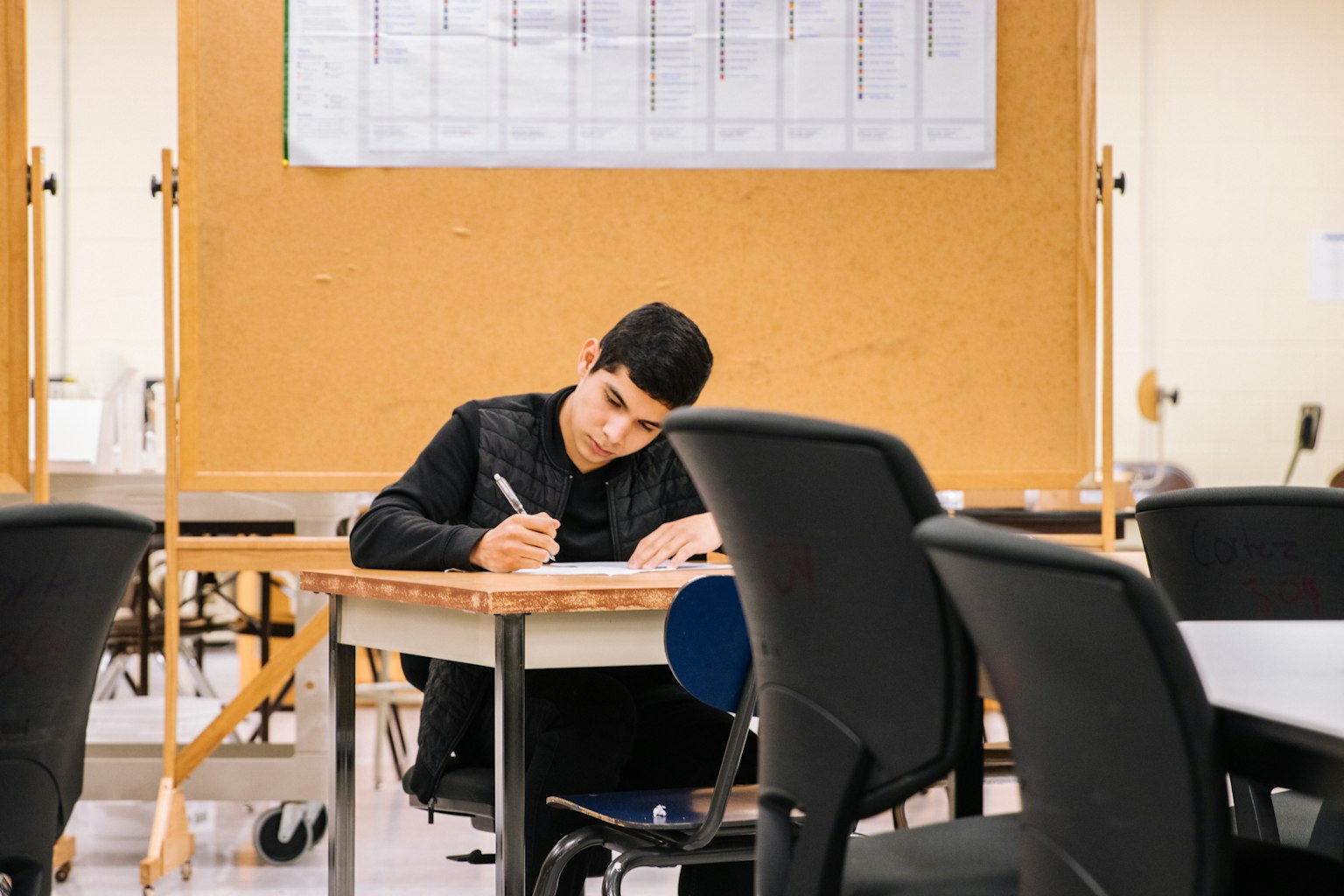
Exams can make your body react as if you are facing a threat. Your heart might beat faster, your hands may shake, your breathing can become shallow, or your mind might suddenly go completely blank. This does not mean that you do not know the answers. Often, stress has temporarily made it harder to reach the information you already have.
Many of the techniques below occupy your working memory with a simple task. They interrupt the negative thought spiral people experience under stress: there is no room left for "I don't know this, I'm going to fail." The good news is that you can use them during an exam without drawing attention to yourself. You do not need to leave the room or do anything other students will notice. Here are six discreet strategies to practise before your next exam.
1. Box breathing
Box breathing is a simple way to slow down when you notice yourself becoming overwhelmed.
Breathe in for 4 → hold for 4 → breathe out for 4 → hold for 4 → repeat
You can imagine tracing the four sides of a square as you count. You could even draw a small square on the back of a page and trace it with your finger. Slow, controlled breathing can help reduce the physical symptoms of stress and give your brain a moment to reset. In an exam, your sympathetic nervous system is more active; this is what causes the faster heartbeat and tense muscles. Slow breathing activates your parasympathetic nervous system, telling your body you are safe and helping you stay calm.
2. Bilateral tapping
Bilateral tapping means gently alternating taps from one side of your body to the other. Under the desk, tap your left and right thighs in turn: left, right, left, right. Keep the movement small and gentle. You could even tap your toes inside your shoes. The steady, repetitive rhythm gives your attention something predictable to focus on and may help interrupt a spiral of anxious thoughts.
3. Ground yourself using your senses
When anxiety starts building, your thoughts may jump into the future: What if I fail? What if I can't answer anything?
Bring your attention back to what is happening right now. Quietly notice:
- 3 things you can see
- 2 things you can feel
- 1 thing you can hear
For example, notice the edge of your desk, the feeling of your feet in your shoes and the sound of someone turning a page. You may know the longer version of this technique, which includes taste and smell. Like the others, it gives your working memory a job, which interrupts the anxiety loop.
4. Press your feet into the floor
Place both feet firmly on the floor and gently press them down. Hold the pressure for a few seconds, then slowly release.
Try silently saying: "Feet down. Press. Release."
This gives your body a strong physical sensation to focus on and can help you feel more grounded, literally. Many people feel calmer when they notice exactly where their body is in space, a sense called proprioception. The movement unfreezes your body and the predictable sensation calms the mind. It is also completely invisible to everyone else in the room.
5. Relax your jaw
Stress often makes us clench our jaw without realising it. Take a moment to check: are your teeth pressed together? If they are, gently relax your jaw. Let your tongue rest comfortably and allow your shoulders to drop slightly. A small physical release can help interrupt the tension and distraction that build up when you are anxious.
6. Use your peripheral vision
When we feel stressed, our attention can become very narrow. We might stare intensely at one question while becoming more and more frustrated. Your eyes use muscles to focus, and the closer an object is, the harder those muscles work.
Without moving your head, soften your gaze and look at something further away. Maybe it is the wall in front of you, the clock or the door. After about 30 seconds, the muscles in your eyes can start to relax.
You could also try this: while still looking at your paper, notice what you can see at the edges of your vision. You are simply widening your awareness for a few seconds before returning to the question.
What if your mind goes completely blank?
Sometimes the biggest problem is the moment you look at a question and suddenly feel as though you have forgotten everything. If this happens, do not immediately decide that you do not know the answer.
Write one thing you know
Don't try to solve the whole question. Write a keyword, formula, definition, fact or number that you recognise. Getting something onto paper gives you a starting point.
Find the smallest possible first step
Ask yourself: "What is the first thing I can do?" Perhaps you can underline important information, identify the topic, draw a diagram or write down what the question is asking.
Search your memory for a connection
Silently ask: "Where have I seen something like this before?" Think about a lesson, a homework question, a worked example or a past paper. Remembering one small connection can help unlock the rest.
Exam emergency reset: stop, write, shrink, search
- Stop: don't panic about the blank.
- Write: write one thing you know.
- Shrink: find the smallest possible first step.
- Search: ask yourself where you have seen something similar before.
Practise these techniques during homework and practice papers so they already feel familiar on the day. Treat your homework as a mini assessment and see how much you remember without your notes. You do not have to feel completely calm to keep going. You only need to feel calm enough to take the next step.
If you'd like help preparing for exams, with the content and with the nerves, get in touch with our team.